FBAR Requirements When Buying Property in Portugal (For U.S. Citizens)
By Pieter Paul Castelein
Published: May 8, 2026
Category: Geographic & Sector Deep Dives
**
# FBAR Requirements When Buying Property in Portugal (For U.S. Citizens)
Updated: February 2026
[Image: U.S. citizens navigating FBAR requirements when purchasing property in Lisbon, Portugal]
## U.S. Compliance Intelligence: Portugal Property FBAR at a Glance
What every American buyer needs to know before transferring funds to Portugal.
• Portuguese real estate itself is NOT reported on FBAR (FinCEN 114), but the bank accounts used to buy it almost certainly are, once the aggregate balance exceeds $10,000 USD at any point during the calendar year
• FATCA Form 8938 thresholds are higher ($50,000 single / $100,000 married filing jointly for U.S. residents; $200,000 / $400,000 for overseas filers), but both forms may be triggered simultaneously by a single Portugal property purchase [https://www.realestate-lisbon.com/buying-guide/financial-concerns]
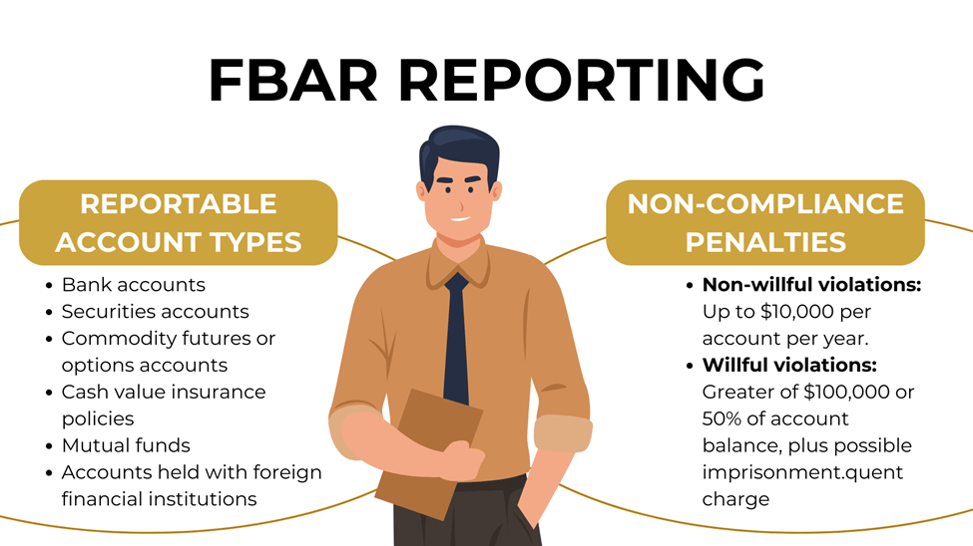
• Penalties for willful FBAR non-disclosure begin at $10,000 per violation per year under 31 U.S.C. § 5321, and willful violations can reach the greater of $100,000 or 50% of the account balance per violation
• FBAR (FinCEN 114) is filed with FinCEN (Financial Crimes Enforcement Network), not the IRS, due April 15, with automatic extension to October 15
• The $10,000 threshold applies to the aggregate of all foreign financial accounts, not each account individually
• Portuguese bank accounts, escrow accounts, and lawyer client accounts (contas clientes) all count as "foreign financial accounts" for FBAR purposes
• Directly held real estate, land or a building in your own name, is explicitly excluded from FBAR reporting under 31 C.F.R. § 1010.350
• Property held through a foreign entity (a Portuguese LDA, for example) may trigger additional FBAR and Form 5471 reporting obligations
• The U.S.-Portugal tax treaty (1994) covers income tax but does not eliminate FBAR filing obligations, these are separate legal requirements
• Portugal's NHR 2.0 tax regime (IFICI, in force from January 2024) reduces Portuguese income tax for qualifying foreign residents but has no bearing on U.S. FBAR obligations
## Does Portugal Real Estate Itself Go on FBAR?
The short answer is no. The Bank Secrecy Act regulations (31 C.F.R. § 1010.350) explicitly exclude "real property" from the definition of a foreign financial account. A Portuguese apartment, vila, or commercial property held directly in a U.S. person's name does not appear anywhere on FinCEN 114.
This is a point of significant confusion because Portugal property purchase guides [https://www.realestate-lisbon.com/buying-guide] focus almost entirely on Portuguese taxes, Imposto Municipal sobre Transmissões (IMT, the transfer tax), Imposto do Selo (stamp duty), and Imposto Municipal sobre Imóveis (IMI, the annual council tax). These local obligations are real and material, but they are entirely separate from U.S. FBAR reporting.
The compliance issue arises one step earlier in the transaction: the accounts used to fund the purchase.
## Which Portuguese Accounts Trigger FBAR When Buying Property?
Any Portuguese bank account, escrow account, or lawyer/notary client account (conta cliente) where a U.S. person has signature authority or a financial interest is a "foreign financial account" for FBAR purposes. The filing obligation is triggered when the aggregate balance of all such accounts exceeds $10,000 USD at any point during the calendar year, not just at year-end.
The following account types commonly arise in a Portugal property purchase and are all reportable:
### Portuguese Personal Bank Accounts
Most buyers open an account with a major Portuguese bank (Millennium BCP, Novo Banco, Caixa Geral de Depósitos, Santander Portugal) to receive transferred funds and pay local expenses. The moment this account holds more than $10,000 USD equivalent, FBAR reporting is triggered.
### Lawyer or Solicitor Escrow Accounts
In Portugal, it is standard practice for the buyer's advogado or solicitador to hold purchase funds in a client account during the period between promissory contract (CPCV) and final deed (escritura). If the U.S. buyer has a financial interest in or signature authority over this account, it is reportable. For guidance on the CPCV and escritura process, see our CPCV vs Escritura guide [https://www.realestate-lisbon.com/guides/cpcv-vs-escritura-in-lisbon-a-buyers-legal-guide]. Working with qualified real estate lawyers [https://www.realestate-lisbon.com/real-estate-lawyers] is strongly advised.
### Portuguese Mortgage Accounts
A mortgage account held at a Portuguese bank constitutes a foreign financial account even if the balance is typically negative (a loan balance). However, FBAR requires reporting accounts with positive balances. If a linked offset or current account holds funds, that account is reportable at its positive balance.
### Developer Escrow Accounts (Off-Plan Purchases)
For new-build or off-plan properties [https://www.realestate-lisbon.com/off-plan], stage payments are often held in a developer's escrow account. U.S. buyers with rights over these funds should seek qualified counsel on whether a financial interest exists. You can explore our Off-Plan Payment Calculator [https://www.realestate-lisbon.com/calculators/off-plan] to model your payment stages and understand when large sums may sit in escrow.
[Image: Portuguese bank accounts and escrow accounts that trigger FBAR obligations for U.S. property buyers]
## FBAR vs. FATCA vs. Portuguese Taxes: How They Interact
Three separate reporting frameworks apply simultaneously to a U.S. person buying property in Portugal. Conflating them is the most common mistake American buyers make.
### FBAR (FinCEN 114)
FBAR is a Bank Secrecy Act report filed with FinCEN. It captures foreign financial accounts (bank, brokerage, pension, and certain insurance accounts) over the $10,000 aggregate threshold. It is not a tax return, it does not calculate tax owed. Failure to file carries independent civil and criminal penalties.
### FATCA (Form 8938)
FATCA is an IRS tax return attachment under the Foreign Account Tax Compliance Act. It captures a broader range of "specified foreign financial assets," including foreign accounts and certain foreign securities. Thresholds are higher than FBAR ($50,000 for single U.S. residents at year-end, or $75,000 at any point during the year). Real estate held directly is also excluded from Form 8938, but the same Portuguese bank accounts that trigger FBAR will often trigger Form 8938 as well. Both forms may be required for the same accounts in the same tax year.
### Portuguese Local Taxes (IMT, IMI, Imposto do Selo)
Portuguese local taxes are obligations to the Portuguese tax authority (Autoridade Tributária e Aduaneira). These are separate from U.S. reporting obligations and are the responsibility of the buyer and their Portuguese fiscal representative (representante fiscal, required for non-EU property owners). You can estimate your IMT exposure with our IMT Tax Calculator [https://www.realestate-lisbon.com/calculators/imt] and get the full picture of upfront costs using the True Cost Calculator for Property [https://www.realestate-lisbon.com/calculators/true-cost].
The U.S.-Portugal income tax treaty signed in 1994 prevents double taxation on income (rental income, capital gains on sale) but creates no exemption from FBAR or FATCA. U.S. citizens remain subject to worldwide income reporting regardless of the treaty.
For specialist guidance on the NHR 2.0 / IFICI tax regime and how it interacts with U.S. obligations, consult our NHR vs IFICI Tax Guide [https://www.realestate-lisbon.com/guides/nhr-vs-ifici-in-lisbon-a-2025-tax-guide-for-buyers] and connect with expatriate tax specialists [https://www.realestate-lisbon.com/professionals/accountants-expatriate-tax-services] experienced in cross-border compliance.
## Portugal Property Purchase Scenarios: FBAR Threshold Examples
The following scenarios illustrate how the $10,000 aggregate threshold applies in practice.
### Scenario A: Cash Purchase, Funds Wired Directly
A U.S. buyer wires €400,000 from a U.S. brokerage to a newly opened Portuguese bank account to fund a Lisbon apartment purchase. The Portuguese account holds €400,000 for approximately 45 days before the escritura is completed and funds are disbursed to the seller. The $10,000 threshold is exceeded on day one. FBAR is required for that calendar year, and Form 8938 thresholds will also be exceeded.
### Scenario B: Lawyer Escrow Account Only
A buyer wires funds directly to their advogado's client account and never personally holds a Portuguese bank account. Whether FBAR applies depends on whether the U.S. buyer has a "financial interest" or "signature authority" over the client account, a fact-specific determination that qualified counsel should assess before assuming no filing is required. Property acquisition lawyers [https://www.realestate-lisbon.com/professionals/real-estate-lawyers-property-acquisition] in Lisbon can help clarify this distinction early in the transaction.
### Scenario C: Small Rental Income Account
After the purchase closes, the buyer opens a Portuguese bank account to collect rental income. If the balance exceeds $10,000 USD equivalent at any point during the year, FBAR is required, even if the only funds are rental receipts and the property purchase occurred in a prior year. Use our Rental Yield Calculator [https://www.realestate-lisbon.com/calculators/rental-yield] to project your income flows and identify when balances may cross the threshold.
### Scenario D: Joint Purchase with Portuguese Spouse
If a U.S. citizen purchases property jointly with a Portuguese national and the Portuguese spouse holds the bank account, the U.S. spouse may have a reportable financial interest depending on community property rules and account control. This scenario requires individual legal analysis.
## Insider Perspective: Cross-Border Coordination for Portugal Buyers
### Market Intelligence
The Portugal property transaction timeline creates a predictable FBAR exposure window that most U.S. buyers are unaware of. The period between signing the promissory contract (Contrato de Promessa de Compra e Venda, or CPCV) and the notarial deed (escritura) averages 60-120 days for resale properties and 12-36 months for off-plan new builds [https://www.realestate-lisbon.com/buying-guide/new-builds-risks]. During this entire period, purchase funds typically sit in a Portuguese bank or escrow account, well above the $10,000 FBAR threshold, creating a filing obligation for that calendar year that many buyers only discover at the next U.S. tax filing deadline.
### Professional Coordination
U.S. buyers working with a Portuguese advogado and a U.S. cross-border CPA or Enrolled Agent simultaneously will identify FBAR and Form 8938 obligations before funds are transferred, not after. The correct sequence is: (1) engage a U.S.-qualified cross-border tax advisor, (2) obtain a Portuguese NIF (tax identification number) and appoint a fiscal representative, (3) open the Portuguese bank account, (4) transfer funds and file FBAR for that calendar year by April 15 (or October 15 with the automatic extension) of the following year.
You can find qualified English-speaking accountants [https://www.realestate-lisbon.com/english-speaking-accountants] and NHR tax regime specialists [https://www.realestate-lisbon.com/professionals/accountants-nhr-tax-regime] through our professional directory. For legal support, our international property law [https://www.realestate-lisbon.com/professionals/real-estate-lawyers-international-property-law] specialist directory is a good starting point. If you need a notary for the escritura, our notaries directory [https://www.realestate-lisbon.com/notaries] lists verified professionals across the Greater Lisbon area.
### Regulatory Nuance
Portugal introduced stricter beneficial ownership registration requirements under RCBE (Registo Central do Beneficiário Efetivo) as part of EU anti-money-laundering directives. U.S. buyers purchasing through a Portuguese LDA or other corporate structure must register the U.S. person as ultimate beneficial owner, a step that also signals to U.S. tax advisors that Form 5471 (foreign corporation reporting) may be required in addition to FBAR and Form 8938. Our legal issues guide [https://www.realestate-lisbon.com/buying-guide/legal-issues] covers corporate purchase structures in more detail.
[Image: U.S. and Portuguese tax professionals coordinating cross-border compliance for Lisbon property buyers]
## Investment Considerations and Compliance Risk Factors
### Penalty Asymmetry
FBAR penalties are disproportionate relative to tax owed. A buyer who held €300,000 in a Portuguese account for 90 days and failed to file FBAR faces a non-willful penalty of up to $10,000 per year under current FinCEN guidance (reduced post-Bittner v. United States, 598 U.S. 85, 2023). Willful violations remain $100,000 or 50% of the account balance per violation, amounts that can exceed the tax owed by orders of magnitude. For a broader view of investment risks [https://www.realestate-lisbon.com/buying-guide/investment-risks] in the Portuguese market, our buying guide covers regulatory, legal, and financial exposures in depth.
### Amnesty Program Availability
The IRS Streamlined Filing Compliance Procedures (Streamlined Domestic or Streamlined Foreign Offshore) remain available for non-willful FBAR failures as of February 2026, providing a defined penalty structure for late or missed filings. These programs are not permanent, they can be discontinued by IRS at any time.
### Currency Fluctuation and Threshold Crossing
The $10,000 FBAR threshold is calculated in USD using Treasury Financial Management Service rates. EUR/USD exchange rate movements mean a Portuguese account balance can cross the reportable threshold without the U.S. owner adding any funds. Buyers should monitor account balances in USD terms throughout the year.
### Year of Sale Obligations
When a Portugal property is sold, the proceeds typically sit in a Portuguese bank account pending repatriation to the U.S. This creates a fresh FBAR filing obligation for the year of sale even if the property has been sold and no longer owned at year-end.
## Step-by-Step: How to File FBAR If You Own Portugal Property
Filing FinCEN 114 for a Portuguese bank account follows the same process as any other foreign account FBAR. The following steps apply specifically to Portugal property owners.
First, identify all reportable accounts. Review all Portuguese bank accounts, any lawyer or notary client accounts over which a financial interest or signature authority exists, and any accounts held in connection with the property (property management accounts, rental escrow accounts).
Second, determine the maximum balance for each account during the calendar year. Use the official Treasury exchange rate for EUR/USD published at the end of the reporting year to convert balances. The applicable rates are published at fiscaldata.treasury.gov [https://fiscaldata.treasury.gov].
Third, confirm the aggregate threshold is exceeded. If the sum of the maximum balances across all foreign financial accounts exceeds $10,000 USD equivalent at any point during the year, FBAR filing is required.
Fourth, file FinCEN 114 electronically by April 15 of the following year. The automatic extension to October 15 requires no action, it is granted automatically. FinCEN 114 is filed separately from the U.S. federal income tax return.
Fifth, retain records. FBAR filers must retain account records for five years from the filing due date under 31 C.F.R. § 1010.420. Filers with Portugal property accounts should have account numbers, IBAN details, and bank addresses available from their Portuguese bank statements.
Need help navigating the full cost picture before you buy? Our tools and calculators [https://www.realestate-lisbon.com/calculators] cover everything from mortgage eligibility to rental yield projections. And for in-depth market context, visit our Market Insights [https://www.realestate-lisbon.com/market-insights] section or the Regulatory and Legal Frameworks blog [https://www.realestate-lisbon.com/blog/regulatory-legal-frameworks].
## FAQ
Does buying a house in Portugal trigger FBAR?
The property itself does not trigger FBAR. However, opening a Portuguese bank account to fund the purchase almost always does, once the account balance exceeds $10,000 USD equivalent at any point during the calendar year.
Do I report the purchase price of my Portugal property on FBAR?
No. Real estate held directly is excluded from FBAR reporting. Only the financial accounts used to purchase, finance, or manage the property are potentially reportable.
What is the deadline to file FBAR for my Portuguese bank account?
April 15 of the year following the reporting year, with an automatic extension to October 15. No extension request is required, the extension is granted automatically.
Do I need to file both FBAR and Form 8938 for my Portuguese accounts?
Possibly. If the Portuguese accounts exceed the FBAR $10,000 threshold, they must appear on FinCEN 114. If they also exceed the Form 8938 thresholds ($50,000 at year-end or $75,000 at any point, for single U.S. residents), they must also appear on Form 8938 attached to the U.S. tax return. The two filings are not mutually exclusive.
Is rental income from my Portugal property reportable in the U.S.?
Yes. U.S. citizens report worldwide income, including Portuguese rental income, on their U.S. federal income tax return. The U.S.-Portugal tax treaty provides mechanisms to avoid double taxation, and Portuguese taxes paid may be creditable against U.S. tax owed via Form 1116. Our Rental Yield Calculator [https://www.realestate-lisbon.com/calculators/rental-yield] can help you project gross income flows before planning your tax position.
What if I bought Portugal property through a Portuguese company (LDA)?
If a U.S. person owns 10% or more of a foreign corporation, Form 5471 may be required in addition to FBAR and Form 8938. The corporate bank accounts of the LDA would be reportable on FBAR if the U.S. shareholder has a financial interest or signature authority. Consult an accountant specialising in property tax [https://www.realestate-lisbon.com/professionals/accountants-property-tax] and a lawyer experienced in due diligence [https://www.realestate-lisbon.com/professionals/real-estate-lawyers-due-diligence] before proceeding with a corporate purchase structure.
Is there a penalty if I forgot to file FBAR for the year I bought my Portugal property?
Non-willful FBAR failures are subject to penalties of up to $10,000 per year under current post-Bittner guidance. The IRS Streamlined Filing Compliance Procedures provide a defined penalty structure for taxpayers who failed to file due to non-willful conduct. Consulting a cross-border tax professional before filing late is strongly advised.
Which Portuguese accounts trigger FBAR when buying property?
Portuguese personal bank accounts, lawyer or solicitor escrow accounts, Portuguese mortgage accounts, and developer escrow accounts for off-plan purchases can all trigger FBAR once the aggregate balance exceeds $10,000 USD at any point during the calendar year. For off-plan projects in Lisbon, see our Lisbon off-plan listings [https://www.realestate-lisbon.com/off-plan/lisbon] and factor in FBAR exposure during the payment stage period.
What is the FBAR aggregate threshold and how does it apply?
The $10,000 FBAR threshold applies to the aggregate of all foreign financial accounts combined, not each account individually. If the sum of maximum balances across all foreign accounts exceeds $10,000 USD equivalent at any point during the year, FBAR filing is required for that year.
Does Portugal's NHR 2.0 (IFICI) tax regime affect FBAR obligations?
No. Portugal's NHR 2.0 tax regime (IFICI, in force from January 2024) reduces Portuguese income tax for qualifying foreign residents but has no bearing on U.S. FBAR obligations. FBAR is a U.S. Bank Secrecy Act requirement entirely separate from Portuguese tax law. For more on IFICI eligibility and benefits, see our NHR vs IFICI Tax Guide [https://www.realestate-lisbon.com/guides/nhr-vs-ifici-in-lisbon-a-2025-tax-guide-for-buyers].