The Future of Real Estate: How Tech, Energy, and Hybrid Use are Shaping Cities
By Mihail Talev
Published: March 3, 2026
Category: technology
### Lisbon Real Estate Enters Tech-Driven Transformation Era—Hybrid Buildings Command Premium Pricing
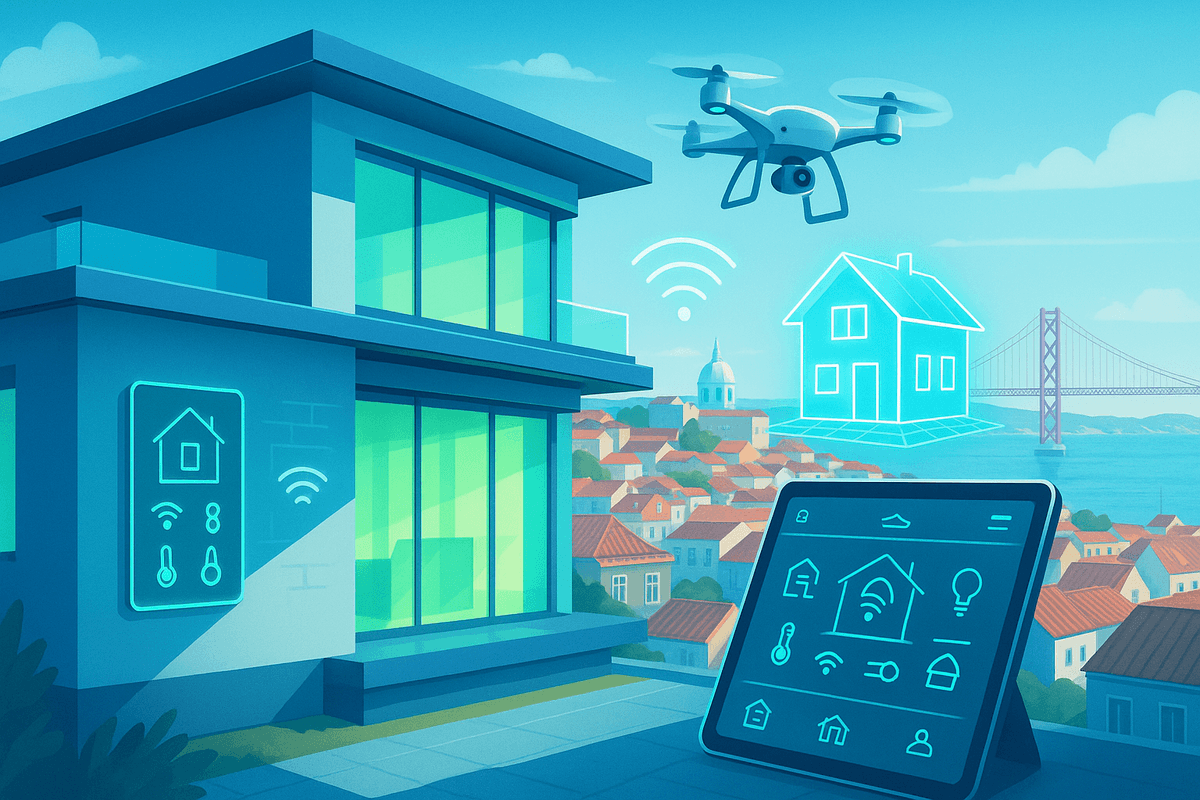
In a structural shift reshaping Portugal's property landscape, **Lisbon's real estate market** is experiencing a fundamental transformation driven by technology integration, energy efficiency requirements, and hybrid-use development models. This evolution, distinct from cyclical market fluctuations, positions buildings combining digital infrastructure, renewable energy systems, and functional flexibility as the premium assets of the next decade, commanding significant valuation premiums across **Greater Lisbon's** diverse neighborhoods.
The integration of artificial intelligence, IoT sensors, and real-time data management systems has evolved from innovative differentiators to baseline requirements for competitive properties. According to market analysis from Lisbon property market insights [https://www.realestate-lisbon.com/market-insights], buildings incorporating these technologies achieve 15-25% higher valuations while delivering superior operational efficiency, lower maintenance costs, and enhanced environmental performance—critical factors for financing and liquidity in an era of increasing ESG investment mandates.
This technological revolution coincides with the emergence of **hybrid-use developments** that integrate residential, commercial, retail, and leisure functions within single properties or compact urban zones. Remote work acceleration has transformed this from niche concept to mainstream demand, with investors and occupiers seeking versatile spaces supporting live-work-play proximity. For foreign investors evaluating **Lisbon's evolving market**, understanding these structural shifts proves essential for identifying assets positioned for sustained appreciation rather than technological obsolescence.
### Key Takeaways
• ✓ Lisbon properties integrating smart building technology command 15-25% valuation premiums while delivering superior operational efficiency
• ✓ Hybrid-use developments combining residential, commercial and leisure functions meet evolving post-pandemic lifestyle demands
• ✓ Energy-efficient buildings with renewable generation capability transform operational costs into strategic assets for ESG-focused investors
• ✓ Buildings lacking technology integration, energy efficiency and functional flexibility face obsolescence risk within investment horizons
**Parque das Nações**, the modern waterfront district 7 kilometers northeast of central Lisbon, exemplifies this transformation. Served by Gare do Oriente transport hub and the Red Metro Line, this former Expo '98 site has evolved into Portugal's premier smart city showcase, where **Vodafone Headquarters** and **Microsoft Portugal** occupy buildings featuring advanced energy management systems, automated climate control, and integrated digital infrastructure. Properties in this district consistently achieve €5,500-7,000/m² valuations, with tech-enabled buildings commanding premiums at the upper range.
The district's success stems from comprehensive infrastructure planning that anticipated hybrid-use demand. Contemporary developments like **Myriad by Sana Hotels** integrate luxury accommodation with conference facilities and residential components, while the **Vasco da Gama Shopping Center** provides retail amenities within walking distance of office towers and residential complexes. This proximity model appeals particularly to international professionals and expatriate families seeking efficient urban lifestyles, driving sustained demand for Parque das Nações off-plan developments [https://www.realestate-lisbon.com/off-plan/lisbon/parque-das-nacoes].
**Chiado** and **Príncipe Real** represent historic districts undergoing tech-enabled revitalization. These central neighborhoods, accessible via the Blue and Green Metro Lines respectively, showcase how traditional Portuguese architecture integrates modern building systems while preserving cultural heritage. Investors acquiring pre-renovation properties for €4,000-5,000/m² frequently invest €1,500-2,000/m² in smart building retrofits, achieving post-renovation valuations of €8,000-10,000/m² while reducing operational costs by 30-40% through energy efficiency improvements.
## Investment Implications of Smart Building Technologies
The shift toward technology-integrated properties creates distinct investment dynamics favoring forward-thinking developers and investors. Buildings incorporating **Building Management Systems (BMS)**—centralized platforms controlling HVAC, lighting, security, and energy consumption through sensor networks and AI algorithms—demonstrate measurable advantages: 25-35% reduction in energy costs, 20% decrease in maintenance expenses, and 15% increase in tenant retention rates. These operational improvements translate directly to enhanced **net operating income** and capitalization rate compression, driving capital appreciation beyond market averages.
Energy efficiency requirements under Portugal's **Energy Performance Certificate (CEP)** framework increasingly influence financing availability and pricing. Properties achieving **Class A energy ratings**—requiring renewable energy integration, superior insulation, and smart consumption management—qualify for preferential mortgage rates from major Portuguese banks including **Caixa Geral de Depósitos** and **Millennium BCP**, while Class C and below properties face financing restrictions. This regulatory environment positions energy-efficient buildings as lower-risk investments with enhanced liquidity profiles, particularly relevant for foreign investors requiring financing or planning future disposals.
The **ESG (Environmental, Social, Governance) investment mandate** represents an additional demand driver. Institutional investors and high-net-worth individuals increasingly allocate capital toward assets demonstrating measurable sustainability metrics. Buildings with integrated solar panels, geothermal heating systems, and real-time consumption monitoring satisfy these criteria while generating premium rental rates. According to agents specializing in international clients [https://www.realestate-lisbon.com/professionals/real-estate-agents-international-clients], ESG-compliant properties in Lisbon achieve 10-15% rental premiums and 20% faster letting periods compared to conventional alternatives.
Technology integration extends beyond individual buildings to neighborhood-scale infrastructure. **5G network deployment** across Greater Lisbon enables smart city applications including intelligent traffic management, automated waste collection, and real-time air quality monitoring. Properties within fully connected districts command location premiums, while buildings lacking high-speed connectivity face obsolescence risk. Foreign investors should evaluate prospective acquisitions' digital infrastructure alongside traditional location factors, consulting with technical inspection professionals [https://www.realestate-lisbon.com/professionals/home-inspectors-pre-purchase-inspections] capable of assessing smart building systems during due diligence.
## Hybrid-Use Development Revolution
The proliferation of **mixed-use developments** represents Lisbon's response to evolving lifestyle preferences accelerated by remote work adoption. Rather than segregating residential, commercial, and retail functions, contemporary projects integrate multiple uses within single buildings or compact urban blocks. This approach maximizes land efficiency while creating 24-hour activity cycles that enhance security, vibrancy, and property values.
**Saldanha**, a central business district served by the Yellow and Red Metro Lines, exemplifies successful hybrid-use transformation. The area's evolution from pure office concentration to integrated live-work destination demonstrates market responsiveness to changing demands. New developments like **Edifício República** combine luxury residences with co-working spaces, fitness centers, and ground-floor retail, achieving €6,500-8,000/m² valuations while maintaining 95%+ occupancy rates across all usage categories.
## Lisbon's Smart City Transformation Context
Lisbon's embrace of smart city technologies positions it among Europe's leading urban innovation hubs. The municipality's **Lisbon Smart City Strategy** encompasses intelligent transportation systems, renewable energy integration, and digital service delivery across multiple districts. This comprehensive approach creates supportive infrastructure for technology-enabled property developments while enhancing overall urban competitiveness.
Several factors drive continued smart city investment:
• **EU Funding Support**: Portugal accesses substantial European Union recovery funds allocated toward digital transformation and green transition projects, providing financial backing for smart city infrastructure that enhances property values in connected areas
• **International Talent Attraction**: Lisbon's success attracting technology companies and skilled professionals creates sustained demand for high-quality, tech-enabled housing and office space, particularly in districts like **Avenidas Novas** and **Campo de Ourique**
• **Sustainability Commitments**: Portugal's national carbon neutrality target for 2050 drives regulatory support for renewable energy integration and energy efficiency improvements, creating favorable conditions for sustainable property investments
• **Tourism Evolution**: Post-pandemic tourism recovery emphasizes quality over quantity, with tech-enabled accommodations commanding premium rates from higher-spending visitors seeking sophisticated urban experiences
These dynamics interact to create sustained tailwinds for technology-integrated developments. Foreign investors benefit from supportive policy frameworks, growing professional infrastructure, and increasing market sophistication. Success stories include Brazilian investors who acquired off-plan properties [https://www.realestate-lisbon.com/off-plan] in **Marvila**—an emerging eastern district benefiting from Metro extension and urban renewal—achieving 40% appreciation during construction while securing properties featuring smart home automation and solar energy systems.
The market's evolution also creates opportunities in specialized segments. **Student housing** developments incorporating high-speed internet, automated access systems, and energy-efficient design achieve 6-8% gross yields, while **senior living facilities** with integrated health monitoring technology command premium pricing from affluent retirees seeking Portuguese residency. These niche markets demonstrate how technology integration enables specialized investment strategies beyond traditional residential or commercial approaches.
## Strategic Investment Considerations
For international investors evaluating Lisbon's tech-driven transformation, strategic positioning requires balancing innovation adoption with proven location fundamentals. Properties in established neighborhoods undergoing smart retrofits—such as **Príncipe Real** townhouses incorporating geothermal heating and home automation—offer lower risk profiles than speculative developments in emerging areas, while still capturing technology premiums. These acquisitions typically require €800,000-1,500,000 investment for 150-250m² properties, with projected 5-7% annual appreciation and 4-5% gross rental yields from expatriate tenants valuing modern amenities within historic settings.
Due diligence for technology-integrated properties demands specialized expertise beyond conventional real estate assessment. Investors should engage structural inspectors [https://www.realestate-lisbon.com/professionals/home-inspectors-structural-inspections] familiar with smart building systems to evaluate sensor networks, automation infrastructure, and energy generation capabilities. Legal review should verify compliance with Portuguese data protection regulations for connected devices and confirm warranty coverage for integrated technology systems. Property acquisition lawyers [https://www.realestate-lisbon.com/professionals/real-estate-lawyers-property-acquisition] experienced in technology-enabled buildings can identify potential liability issues and ensure appropriate documentation for system maintenance and updates.
Financing strategies should account for technology premiums and potential obsolescence risks. Portuguese banks increasingly offer **green mortgages** with preferential rates for energy-efficient properties, while some international lenders provide specialized products for smart building acquisitions. Investors should model technology replacement cycles—typically 7-10 years for major systems—when calculating long-term ownership costs and exit values. Consultation with property tax specialists [https://www.realestate-lisbon.com/professionals/accountants-property-tax] helps optimize ownership structures and identify available incentives for sustainable property investments.
Portfolio diversification within Lisbon's tech-enabled market enables risk mitigation while capturing transformation benefits. Combining established district properties with emerging area developments balances stability with growth potential, while mixing residential, commercial, and mixed-use assets provides income diversification. A typical HNWI allocation might include: a renovated apartment in **Chiado** (€1.2-1.8 million) for lifestyle and appreciation; a smart office unit in **Parque das Nações** (€800,000-1.2 million) for rental income; and an off-plan hybrid-use development in **Matinha** (€600,000-900,000) for growth exposure, accessible through mega-regeneration project opportunities [https://www.realestate-lisbon.com/off-plan/lisbon/matinha].
## Future Outlook: Lisbon's Tech-Enabled Property Market
Lisbon's real estate market enters 2026 positioned at the intersection of technological innovation and urban evolution. Analysts project continued outperformance for smart buildings and hybrid-use developments, with technology-integrated properties appreciating 8-12% annually compared to 5-7% for conventional alternatives. This premium reflects growing recognition that buildings lacking digital infrastructure, energy efficiency, and functional flexibility face accelerated obsolescence in an increasingly connected and sustainability-focused market.
The transformation extends beyond individual properties to neighborhood-scale evolution. Districts embracing smart city integration—**Parque das Nações**, **Avenidas Novas**, and emerging **Marvila**—are positioned to capture disproportionate investment and talent inflows, driving sustained demand for quality developments. For foreign investors, this creates opportunities to participate in Portugal's evolution from traditional Southern European market to technology-enabled urban hub while benefiting from eurozone stability and favorable tax environments.
Looking ahead, successful Lisbon property investment will increasingly favor those who recognize real estate as an ecosystem rather than mere construction. Buildings combining technological sophistication, energy independence, and functional adaptability represent the new generation of urban assets—positioned for sustained appreciation while delivering enhanced user experiences and operational efficiency. For sophisticated investors seeking exposure to Europe's smart city transformation, consultation with investment-focused agents [https://www.realestate-lisbon.com/professionals/real-estate-agents-investment-properties] and comprehensive investment analysis tools [https://www.realestate-lisbon.com/calculators/investment-analyzer] provides essential guidance for navigating Lisbon's tech-enabled property landscape. For expert guidance on positioning your portfolio for Portugal's smart city future, contact realestate-lisbon.com [https://www.realestate-lisbon.com].