Portuguese Real Estate Leaders Dispute EU's 35% Overvaluation Claim, Citing 'Distorted' Data
By Pieter Paul Castelein
Published: November 14, 2025
Category: market-trends
### Portugal Property Market Defends Against EU 35% Overvaluation Warning Amid Supply-Demand Imbalance
Portugal's real estate sector has forcefully rejected a **European Commission report** claiming Portuguese housing is 35% overvalued, arguing the analysis relies on flawed statistical models that ignore market fundamentals. Leading industry figures contend Brussels' methodology produces misleading conclusions by applying uniform metrics across vastly different European economies without accounting for Portugal's specific structural challenges.
The dispute highlights fundamental disagreements about **housing market valuation** methodologies and their implications for foreign investors evaluating Portuguese real estate opportunities. With nearly two million Portuguese earning minimum wage, industry leaders argue price-to-income ratios reflect structural economic realities rather than speculative bubbles.
### Key Takeaways
• ✓ EU Commission claims Portuguese housing 35% overvalued using econometric models
• ✓ Portuguese real estate leaders argue data distorts actual market conditions
• ✓ Low national wages artificially inflate price-to-income ratios
• ✓ Structural supply-demand imbalance drives prices rather than speculation
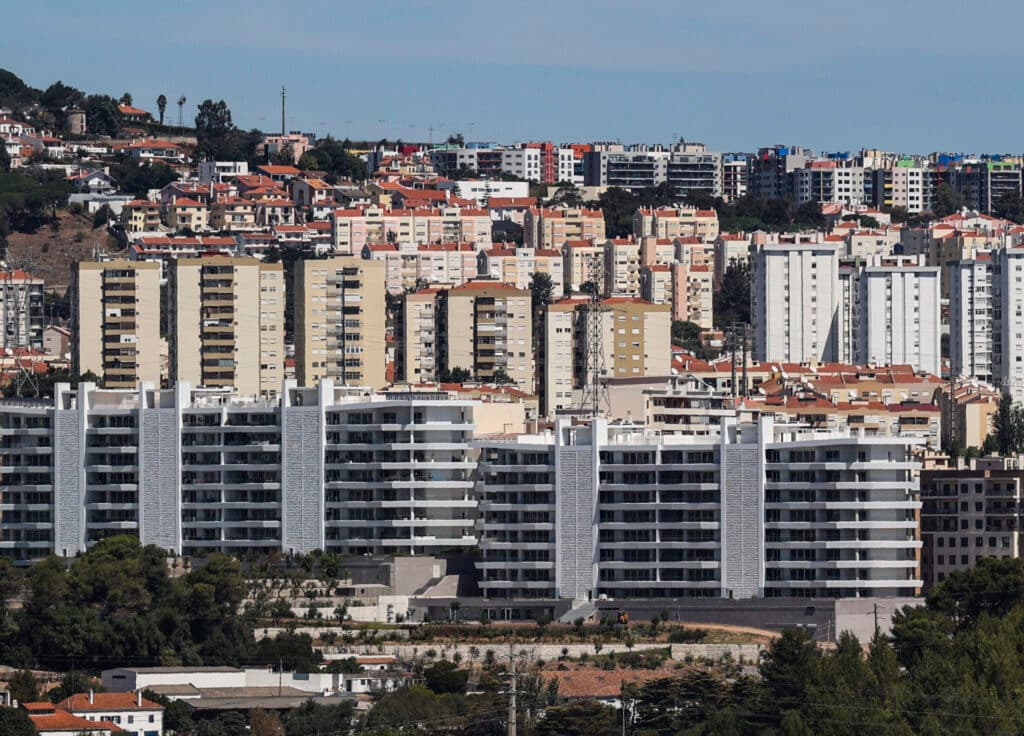
The controversy centers on **Parque das Nações**, Lisbon's modern waterfront district 7 kilometers northeast of the city center, served by Gare do Oriente and Metro Red Line, where international corporate presence drives premium residential demand. Similar dynamics play out across **Portugal's major urban centers**, from Porto's riverside districts to Cascais's coastal developments, where foreign investment intersects with limited housing supply.
These locations attract global investors seeking European real estate exposure [https://www.realestate-lisbon.com/market-insights] in stable markets, but face structural constraints including restrictive zoning, lengthy permitting processes, and limited construction financing that restrict new supply. For comprehensive market analysis, see our Lisbon neighborhoods guide [https://www.realestate-lisbon.com/lisbon-real-estate-neighborhoods].
## Market Implications for Investors
The EU overvaluation claim carries significant implications for **foreign real estate investors** evaluating Portuguese opportunities. If Brussels' analysis gains traction, regulators might impose cooling measures affecting mortgage availability, foreign buyer restrictions, or tax policies targeting property investment.
However, **industry counterarguments** suggest the market reflects fundamental supply-demand dynamics rather than speculative excess. With Portugal constructing approximately 15,000 new homes annually against estimated demand of 30,000, the structural shortage supports current pricing levels. This scenario presents long-term investment opportunities [https://www.realestate-lisbon.com/investment-and-strategy-guides] for investors recognizing demographic and economic drivers.
The dispute also highlights **methodological challenges** in cross-border real estate analysis. Portugal's relatively low wage structure—where median monthly income remains below €820—creates distorted price-to-income ratios when compared to Northern European benchmarks, potentially masking underlying market health for investors focused on rental yields and capital appreciation rather than local affordability metrics.
## Industry Leadership Perspective
**Manuel Maria Gonçalves**, CEO of the Portuguese Association of Real Estate Developers and Investors (APPII), represents Portugal's largest property development trade association, advocating for policy reforms to increase housing supply. His critique emphasizes that EU models assume market equilibrium would emerge with higher supply and incomes, ignoring Portugal's specific economic structure where low wages reflect broader European competitiveness challenges rather than temporary distortions.
**Ricardo Guimarães**, director of Confidencial Imobiliário, operates Portugal's leading real estate data analytics platform, providing market intelligence to institutional investors and developers. His focus on practical solutions reflects industry consensus that addressing housing accessibility requires coordinated policy interventions including streamlined permitting, public-private partnerships, and targeted incentive programs rather than market suppression measures.
## Portuguese Housing Market Context
Portugal's residential market operates within complex structural constraints that differentiate it from Northern European peers. While **foreign investment** has intensified since 2014, driven by Golden Visa programs, non-habitual resident tax benefits, and comparative European pricing, domestic supply mechanisms remain constrained by regulatory and financing limitations.
Several factors continue influencing Portugal's housing dynamics:
• **Restricted Supply**: Construction rates remain 50% below estimated demand despite rising prices, creating persistent shortages
• **Foreign Capital**: International buyers comprise 15-20% of transactions in prime locations, supporting price levels independent of domestic wages
• **Tourism Integration**: Short-term rental platforms absorb significant urban inventory, reducing long-term rental supply
• **Demographic Pressures**: Urbanization trends concentrate demand in Lisbon and Porto while rural areas experience population decline
These elements combine to create **multi-speed markets** where prime locations attract global capital while secondary cities maintain affordability, requiring nuanced investment strategies rather than broad national approaches.
## Investment Considerations
Foreign investors should interpret the EU warning as highlighting **affordability challenges** rather than market collapse risk. Portugal's housing shortage represents a structural opportunity for investors focusing on rental housing development, student accommodation, or senior living sectors where demand exceeds supply across all price points.
However, investors must navigate complex regulatory environments [https://www.realestate-lisbon.com/english-speaking-lawyers] where local knowledge proves essential. Municipal permitting varies significantly, with Lisbon and Porto implementing restrictive measures while secondary cities actively encourage development through expedited processes and tax incentives.
**Strategic positioning** requires understanding demographic drivers including growing tech sector employment, international student populations, and retiring Northern Europeans seeking Mediterranean lifestyles. These segments create sustainable rental demand independent of domestic wage constraints, supporting investment cases even amid affordability concerns.
## Looking Ahead
The EU overvaluation dispute likely intensifies scrutiny of **Portuguese housing policy**, potentially accelerating supply-side reforms that benefit developers and investors positioned for increased construction activity. Government recognition of structural shortages may translate into streamlined approvals, public land releases, and financing support mechanisms.
For investors, the controversy reinforces Portugal's **two-tier market structure** where foreign capital flows into premium segments while domestic affordability challenges persist. Success requires targeting supply-constrained niches with sustainable demand drivers rather than broad market exposure. For expert guidance on navigating Portugal's complex market dynamics, contact realestate-lisbon.com [https://www.realestate-lisbon.com/].